
What Drew Me In
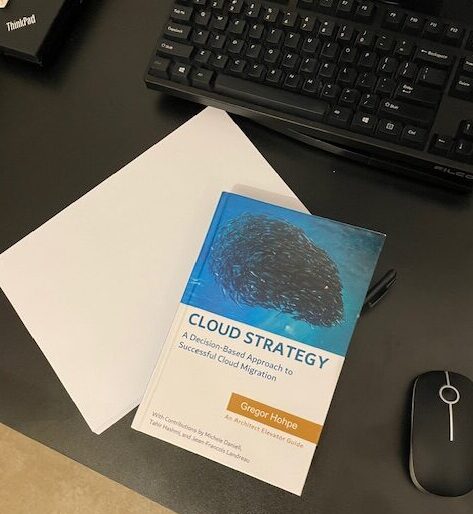
Being a cloud migration and transformation software architect, I would often state in Software Transformation Series, that the toughest challenges are not only technical. As a matter of fact, they’re strategic, organizational, and cultural. I selected Cloud Strategy because I required something beyond cloud provider guides or tooling lessons, which allow me to make strategic decisions in evolving technology landscape. I wanted a richer, experiential insight into how to think about the cloud, not how to use it.
There is no copy-paste for transformation. So, this book likely won’t tell you exactly what to do. But it will allow you to make better decision for yourself.1
Gregor Hohpe is well known for combining architecture with metaphors and grand-scale thinking. I read this book because it claimed to bridge the gap between technology choices and business outcomes, and deliver street-smart insight from real transformations—not cloud utopias conceptualized in theory.
Strategy is the difference between making a wish and making it come true.
I work as a transformation specialist and software architect and continue to cooperate with organizations trying to get away from legacy systems to cloud-native approaches, while at the same time fighting with organization design, funding models, team autonomy, and long-term architectural responsiveness issues. That’s why This book felt especially relevant.

Key Insights
💡 Understanding the Cloud Lifestyle
This part of Cloud Strategy begins by addressing an important topic that is often overlooked during cloud migration and broader transformation efforts..
What we must always keep in mind during any transformation or migration journey is that it’s not just about modernizing infrastructure or designing new architectures to meet market demands, but it’s also about driving a cultural shift within the company itself.
A cloud platform isn’t an additional element that you add to your IT portfolio. It resembles full on IT outsourcing more that IT procurement.
Cloud Strategy continues on to challenge traditional IT corporations in two key areas: the procurement process and the operational process. As described, procurement is the process of acquiring the software and hardware a company needs to operate.
Procurement in IT typically manages licenses and hardware repairs. However, with cloud technology, costs can be more flexible and scalable, offering elasticity in pricing.
Another IT procurement area cloud technology has challenged is the traditional feature checklist approach. In the past, firms employed extensive lists of features to evaluate and meet enterprise requirements. With today’s wide variety of available services, both technologically and financially, cloud vendors spend less time checking boxes and more on offering a strategic road-map of how their services can help an organization reach its goals.
IT has always been product-focused because that is the reason for running an IT company in the first place. The cloud is a platform, though, that presents huge potential for writing software and delivering products to customers.
Cloud vendors allow users to pick from hundreds of options, allowing technology choices to be made at a worldwide or global level. IT groups, as a comparison, focus more on locally optimizing solutions through best-of-breed approaches.
Cloud Strategy continues in this part with new section which discuss the intricate relation between cloud computing and first derivatives. It explains that companies operating in IT and digital fields do not have the luxury of a fixed, clearly defined end state. Instead, they operate in an environment shaped by constant change and continuous adaptation. This section continues by exploring the meaning of absolute in a constantly changing world. It explains that organizations operating in environments of continuous change tend to think and communicate in relative terms, as fixed absolutes have limited relevance for them.
Chapter 3 begins with the statement, Wishes are free, but they rarely come true. The chapter uses this idea to introduce the topic of strategy, explaining what strategy means, how goals are defined, and how intentions can be turned into reality. While it costs nothing to wish for outcomes, turning those wishes into results requires clear direction and deliberate action. This is the role of strategy.
The chapter presents different perspectives on strategy. One view describes strategy as making meaningful choices; another sees it as defining clear goals and aligning actions toward them. Ultimately, the chapter concludes that strategy can be understood as the combination of creativity and discipline. It needs creativity to imagine new possibilities, and discipline to execute them effectively.
Chapter 4 moves from general strategy to make the strategy real required for cloud adoption. It explains that strategy is shaped by the key decisions that define an organization’s journey. The decisions we make influence the strategy, while at the same time the strategy itself guides future decisions. In complex socio-technical systems, architects play an important role by enabling disciplined and consistent decision-making.
It illustrates this relationship by showing how strategy leads to guiding principles. When these principles are applied consistently, they shape decisions. From these decisions emerge concrete options and choices.
This chapter emphasizes that defining a clear set of guiding principles is an essential first step in developing any effective strategy, particularly in the context of cloud transformation.
Cloud Strategy concludes this part by discussing the selection of tools that match the maturity and needs of a cloud strategy. It emphasizes that not every cloud feature or tool is suitable for every organization.
The value of a tool does not depend on how modern or advanced it is, but on whether it is actually used and supports the organization’s objectives.
The chapter also highlights the difference between capability and benefit. A cloud feature may offer many capabilities, but this does not automatically mean it delivers value to a specific project or organization. Capability and benefit are not the same, and effective cloud strategy requires selecting tools based on the practical value they provide rather than on their technical potential alone.
💡 Cloud-Ready Organization
This part focouses how organizations can align themselves with cloud technology and begin their transformation journey. It includes a quote from Mark Birch, Regional Director at Stack Overflow in APAC, highlighting that organizational transformation cannot be copied from elsewhere.
There is no Stack Overflow for transformation where culture change can simply be copied, pasted, and made to work. Each organization must develop its own approach based on its specific context and challenges.
As the second part of Cloud Strategy, it focuses on organizational architecture. It explores how structure, culture, and ways of working must evolve alongside technology, and it is organized into five chapters that address these aspects in detail.
This part starts with outsourcing and explains that cloud computing can be understood as a form of outsourcing, but one that differs significantly from traditional models. Unlike conventional outsourcing, cloud services provide organizations with a high degree of control and transparency over their resources and operations.
Cloud services are typically based on short-term commitments and usage-based pricing. Although cloud providers may encourage longer-term or larger commitments, organizations generally pay only for what they use and can scale resources up or down as needed. This flexibility allows outsourcing in the cloud to be evolutionary rather than fixed, enabling organizations to adapt gradually as their needs change.
The next section discusses the types of teams involved in the cloud journey and how team structures can shape an organization. Drawing on the concepts from the book Team Topologies by Matthew Skelton and Manuel Pais, it explains how organizational design evolves alongside cloud adoption.
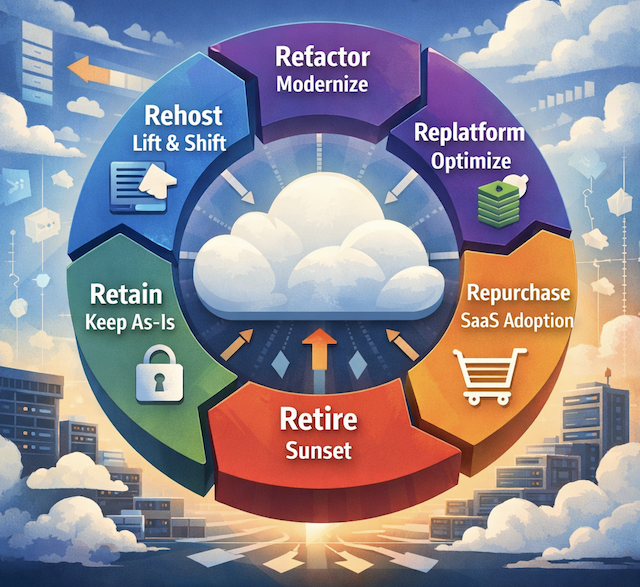
The following section introduces the four Rs of workforce migration, which describe how people transformation accompanies organizational transformation during a cloud journey.
- Retain, meaning that some existing roles and employees continue to be relevant and can remain in place.
- Re-Skill, which is common in infrastructure and operations roles.
- The third one is Replace. Not all roles or individuals can transition to new requirements, and in some cases organizations need to bring in new talent with the necessary skills.
- Retire, referring to roles that are no longer needed as technology and processes change.
This section concludes by discussing enterprise architecture in the context of cloud adoption and how enterprise architecture evolves during migration to the cloud. After defining the role and purpose of enterprise architecture, the book describes its transformation through several phases as organizations move toward cloud-based operating models.
It explains that enterprise architects in a cloud-focused organization must move away from a purely prescriptive role. Instead, they become cloud advocates at the strategic level, helping guide decisions in the boardroom, while also acting as sparring partners for technical teams working on implementation.
💡 Moving to the Cloud
The third part of Cloud Strategy focuses on best practices and common pitfalls encountered during the move to the cloud. It highlights the challenges that architects and managers frequently face during cloud transformation and aims to help organizations avoid typical mistakes. This section is structured into seven chapters, each addressing specific risks, lessons learned, and practical guidance for navigating the cloud journey successfully.
This part begins by examining the reasons organizations choose to move to the cloud. The author outlines several valid motivations for cloud adoption, emphasizing that companies may prioritize these reasons differently depending on their goals and circumstances. Cost is identified as one of the most important drivers. Other key reasons include improved uptime and reliability, greater scalability, better performance, increased delivery velocity, stronger security capabilities, and enhanced transparency in operations and usage.
The next section of Cloud Strategy discusses common misconceptions about moving to the cloud. It explains that the cloud should not be understood simply as infrastructure or as a replacement for servers. The chapter emphasizes that servers themselves are expensive assets that consume significant energy and quickly become obsolete, often within a few years. The real value of the cloud lies not in replacing hardware, but in enabling faster software delivery and greater business agility. Cloud adoption increases development velocity, allowing organizations to deploy software more quickly and reduce time to value for the business, while also lowering the need for ongoing hardware investment.
The section explains that when large organizations move to the cloud, certain topics become particularly important due to existing structures, systems, and operational requirements.
Among these considerations is onboarding, ensuring that teams and workloads can move to the cloud in a structured and manageable way. Hybrid network is another key aspect, as many enterprises migrate gradually and need to operate both on-premises and cloud environments at the same time. The use of virtual private clouds (VPCs) is highlighted as a way to maintain control, security, and network isolation in the cloud.
The next chapter focuses on how organizations can avoid losing direction during cloud migration. The author describes three main phases that help structure the migration journey. The first phase is planning and staffing, which involves defining objectives, preparing the organization. The second phase is execution, where workloads and systems are moved or transformed. The third and final phase is validation, during which organizations verify that the migration has achieved its intended outcomes and that systems operate as expected. Together, these three phases provide a structured approach to managing cloud migration in a controlled and effective way.
💡 Architecting the Cloud
Cloud Strategy focuses on architecting for the cloud and is aimed specifically at software architects and cloud architects in part 4. It provides practical guidance on how architectural decisions should be made in a cloud environment. The chapter emphasizes decision models, explaining how structured and well-informed decision-making helps architects manage complexity, balance trade-offs, and design systems that align with both technical and business goals during cloud adoption.
Introduction to hybrid and multi-cloud approaches comes first. Hybrid cloud is defined as a combination of cloud and on-premises environments, where workloads are distributed across both. Multi-cloud, in contrast, refers to the use of services from more than one cloud provider.
The chapter then outlines five different multi-cloud approaches. Arbitrary, segmented, choice, parallel, portable. These models help architects understand the different ways multi-cloud strategies can be structured depending on their technical and business objectives.
The next chapter describes eight ways to approach hybrid solution for separation between cloud and on-premises environments. These include factors such as tier, generation, criticality, lifecycle, data classification, data freshness, operational state, and workload demand. This structured approach helps define hybrid solutions that balance technical requirements, business needs, and operational constraints.
In the next step, the author explains hybrid implementation strategies for enterprises, a topic particularly relevant for architects. The chapter presents four common approaches to implementing hybrid cloud, each with its own advantages and trade-offs.
- Defining a shared abstraction layer, where a uniform runtime or managed layer is applied across both cloud and on-premises environments.
- Copying the cloud to on-premises, which involves replicating cloud-like environments within the organization’s own data center using hardware or software solutions that mirror cloud capabilities.
- Copying on-premises to the cloud, meaning that existing virtualization environments are reproduced in the cloud to enable smoother migration and operational continuity.
- Making on-premises look like the cloud, where existing infrastructure is enhanced with additional layers so that it integrates more easily with cloud management and operational models.
This part concludes with two important topics. The first is the changing role of multi-tenancy in cloud computing. The author argues that traditional multi-tenant architectures are becoming less necessary, as cloud technology enables what can be described as multi-single tenancy. In this model, systems behave similarly to multi-tenant solutions but without the same level of architectural complexity.
The second topic is the new meaning of elasticity, introduced as the concept of disposability. Through automation and practices such as software-defined infrastructure, organizations can prioritize replaceability over longevity. Disposability refers to how easily a component, for example a server, can be discarded and recreated when needed.
💡 Building for the Cloud
In this part Cloud Strategy explains how cloud platforms change the way applications are designed, built, and operated. It emphasizes that the cloud is not only an infrastructure change but also an application and architecture shift The section discusses how platforms evolve, how application design becomes more application-centric rather than infrastructure-centric, and how modern approaches like containers, serverless, and platform tooling influence development and delivery.
First chapter explains that developing an application-centric cloud strategy involves more than simply building and running software. The author introduces the four-leaf clover model, where the application is placed at the center and treated as a service. Surrounding it are four essential elements: communication, the delivery pipeline, monitoring and operations, and the runtime platform. Together, these four areas support the application and ensure that it can be developed, deployed, and operated effectively in the cloud. The model emphasizes that successful cloud strategy requires aligning these supporting capabilities around the application rather than focusing only on infrastructure.
The next chapter discusses the idea that serverless means worry less?, explaining what serverless actually represents in a cloud context. The author clarifies that serverless does not mean that servers no longer exist, but that infrastructure management is largely handled by the cloud provider. In a serverless model, applications are typically stateless, run in short-lived compute containers, and are triggered by events rather than running continuously. These workloads are ephemeral and fully managed by a third party, allowing development teams to focus more on application logic and less on infrastructure operations.
The next chapter describes the key characteristics of cloud applications using the FROSST model. According to the author, cloud-native applications typically share six important qualities: they are frugal, making efficient use of resources; relocatable, meaning they can run in different environments; observable, allowing their behavior and performance to be monitored; seamlessly updatable, enabling changes without service disruption; internally secured, with security built into the application itself; and failure tolerant, designed to continue operating despite failures. The author explains what each of these characteristics means in a cloud context and concludes by discussing when this model should be applied, helping architects and teams decide in which situations these principles are most relevant.
The next chapter describes the key characteristics of cloud applications using the FROSST model. According to the author, cloud-native applications typically share six important qualities: they are frugal, making efficient use of resources; relocatable, meaning they can run in different environments; observable, allowing their behavior and performance to be monitored; seamlessly updatable, enabling changes without service disruption; internally secured, with security built into the application itself; and failure tolerant, designed to continue operating despite failures. The author explains what each of these characteristics means in a cloud context and concludes by discussing when this model should be applied, helping architects and teams decide in which situations these principles are most relevant.
💡 Embracing the Cloud
In the final part of the book, the author discusses the considerations organizations face after fully embracing the cloud following migration. This section focuses on lessons learned from cloud adoption and reflects on topics such as cost management, economic impact, efficiency, and long-term operational improvements. It explains how organizations can continue to optimize their cloud usage, balance costs with value, and refine their practices to achieve sustainable benefits from their cloud strategy.

My Reflections
Reading Cloud Strategy prompted me to reflect not only on cloud technology concept itself, but on the broader shift in how organizations think about change, decision-making, and value creation. The book reinforces the idea that cloud adoption is not primarily a technical transition. It is an organizational and cultural transformation that requires clarity of purpose, disciplined decision-making, and a willingness to move away from fixed targets toward continuous adaptation. As someone working at the intersection of technology and transformation, this perspective strongly resonates with my own experience.
One of the key reflections for me is how the book consistently moves the discussion away from infrastructure and toward applications, people, and outcomes. For developers and architects, this is an important reminder that cloud success does not come from using modern tools alone, but from aligning architecture, delivery, operations, and communication around business value. The application-centric view, together with concepts such as disposability, observability, and failure tolerance, reflects a maturity model that many organizations still struggle to reach in practice.
From an architectural perspective, the emphasis on decision models and guiding principles stands out. Architecture in the cloud is less about defining static standards and more about enabling informed choices within changing constraints. The shift of architects from prescriptive roles to enablers and sparring partners mirrors what I have observed in successful transformations: architects create direction and coherence, but avoid becoming bottlenecks. Strategy becomes effective only when it translates into consistent decisions across teams.
For technologists and engineering leaders, the book also highlights an important mindset change. Cloud removes many traditional technical limitations, but in doing so introduces new complexity. Multi-cloud, hybrid environments, platform teams, and serverless architectures all increase optionality. The challenge is no longer access to capability, but the discipline to select what truly creates value. This distinction between capability and benefit is one of the most practical lessons throughout the book.
As a transformation expert, I found the discussion around organizational change particularly relevant. The four Rs of people transformation — retain, reskill, replace, and retire — acknowledge a reality that is often underestimated in technology initiatives. Cloud transformation succeeds or fails not because of technology choices, but because organizations manage change in skills, responsibilities, and culture effectively. The idea that there is no “copy and paste” transformation is both realistic and necessary.
Overall, my reflection is that Cloud Strategy succeeds in framing cloud not as an end state, but as an ongoing journey. It encourages developers, architects, and technology leaders to think beyond migration and toward sustainable operating models. The book does not provide a single blueprint, but rather a way of thinking, one that values adaptability, disciplined creativity, and alignment between technology and business outcomes. This perspective makes it particularly valuable for professionals responsible not only for building systems, but for shaping how organizations evolve through technology.

Putting It Into Practice
In real projects, the most practical value of Cloud Strategy is how it helps you turn we should move to the cloud into a set of decisions you can actually execute. A good starting point is to translate your cloud strategy into guiding principles and decision models that teams can apply daily:
- What do we buy vs build
- What do we standardize vs allow teams to choose
- What does DONE mean for security, observability, and resilience.
This avoids the common failure mode where cloud becomes a collection of tools rather than a coherent operating model.
For developers and architects, the quickest way to apply the book is to make applications the center of the strategy and use the four-leaf clover framing as a checklist for every product:
- Delivery pipeline (automated CI/CD, infrastructure-as-code)
- Runtime platform (containers/serverless, managed services)
- Monitoring & operations (logs/metrics/traces, SLOs, on-call readiness)
- Communication (clear ownership, interfaces, and collaboration patterns)
In an e-commerce modernization, for example, you can start by carving out a few high-change components and implement them with cloud-native characteristics (FROSST): make them observable, seamlessly updatable, failure-tolerant, and secured from day one, rather than treating those as Phase 2 improvements.
The book is also very actionable for event-driven systems, where cloud can remove operational burden and increase speed. If you’re migrating something like a fraud detection workflow, you can use serverless and managed messaging to build an event pipeline: transactions emit events, rules and scoring functions run statelessly, and the system scales with demand.
Architects can apply the hybrid and multi-cloud guidance here too: keep sensitive datasets or latency-critical dependencies on-prem if needed, while moving the event processing and analytics to cloud.
From a transformation perspective, the book’s people and org guidance maps cleanly to what you see in delivery: identify the four Rs early (retain, reskill, replace, retire) and build a training-and-transition plan around the target platform and operating model. In practice, that means reskilling operations teams toward automation and platform engineering, turning infrastructure teams into platform teams that enable stream-aligned product teams, and making culture change measurable through working agreements: deployment frequency, lead time, incident recovery, and operational ownership.
Finally, the book helps you stay pragmatic about tooling. It means using the maturity of your strategy to choose tools, not the other way around. In real migrations, this shows up as deliberately limiting platform choices at first , then expanding only when teams can demonstrate benefit. That keeps cloud adoption focused on outcomes like faster time-to-value, safer change, and clearer cost accountability, rather than turning into a modern tech showcase that’s hard to operate.

The Verdict
Cloud Strategy is a strong and practical book for anyone involved in cloud transformation because it focuses on thinking rather than tooling. Its value lies in helping readers understand cloud as an organizational and architectural shift rather than a technical upgrade. In particular, the book stands out because it:
- Connects strategy, architecture, and organizational change into one coherent narrative
- Emphasizes decision-making, guiding principles, and real trade-offs instead of vendor-specific solutions
- Explains cloud adoption from a practical transformation perspective, including people and culture
- provides architects and technology leaders with frameworks that remain relevant regardless of technology trends
However, this book is NOT intended for readers looking for hands-on technical guidance or deep coverage of specific platforms. It does not teach how to use particular cloud services or technologies such as Amazon Web Services, Google Cloud Platform, or Microsoft Azure, nor does it serve as an implementation manual. Readers seeking detailed technical tutorials or platform-specific best practices may therefore find it less suitable, while those interested in strategy, architecture, and transformation will benefit the most.

Complementary Resources
If you’re looking to explore Cloud Strategy and related topics more deeply, I recommend:
- Interview: Gregor Hohpe Reveals The Best Platform Strategies For Success!
- Book: Platform Strategy: Innovation Through Harmonization
- Book: The Software Architect Elevator: Redefining the Architect’s Role in the Digital Enterprise
- Blog: Systemic Event Discovery Approach
- Cloud Strategy: A Decision-Based Approach to Successful Cloud Migration, Gregor Hohpe ↩︎