❌ Why Transformation Stalls
Digital transformation is no longer optional. Enterprises are under constant pressure to deliver new digital services, engage customers across channels, and respond to market changes with speed. Yet according to industry surveys, nearly 70% of transformation programs fail to meet expectations1.
The culprit? More often than not, it’s the weight of legacy systems. Core applications built decades ago still run mission-critical processes, but they resist change. Furthermore, they are costly to maintain, tightly coupled, and difficult to integrate with modern cloud, mobile, or AI-driven solutions.
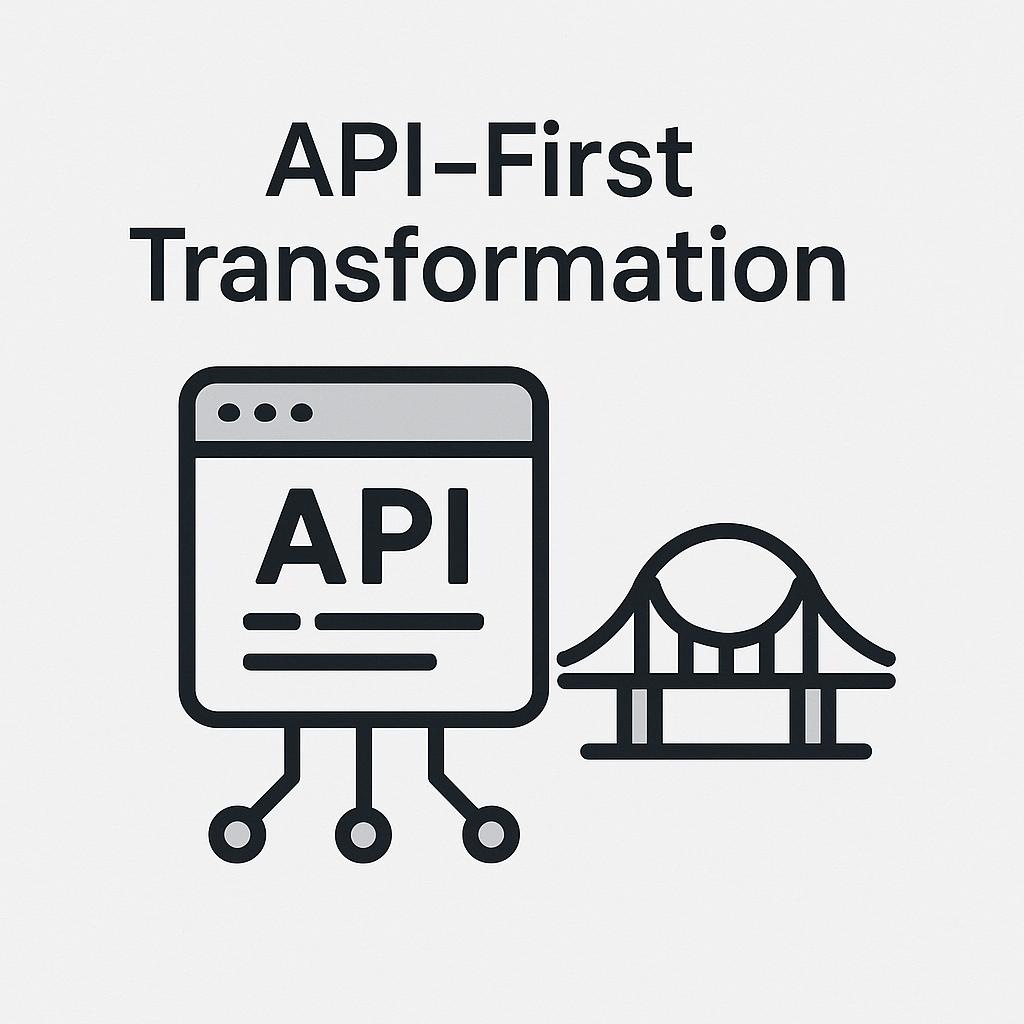
This is where API-First Transformation enters the stage. Rather than forcing a risky rip-and-replace, it offers a path to unlock the value of legacy while paving the way to modernization.
This article is the first in series exploring API-First Transformation, what it means, why it matters, and how organizations can apply it to evolve from legacy-bound to future-ready.
🔗 The Challenges of Transformation
Legacy systems are a paradox. They are both the backbone of operations and the bottleneck to innovation. This paradox makes the transformation challenging and difficult. For example, legacy platforms are stable and proven, but slow to adapt. Any change risks disrupting critical processes.
Furthermore, over the years, organizations have layered countless point-to-point integrations on top of legacy cores. This spaghetti architecture makes every new integration slower and costlier.
From business point of view, while IT teams struggle with technical debt, business leaders face missed opportunities, delayed product launches, inability to support omnichannel experiences, and difficulty partnering with digital-first ecosystems.
Replacing legacy in a single big-bang project is risky, financially, technically, and organizationally. This is why many transformations stall and could be named as the other API-First Transformation.
🔄 API-First as a Strategic Shift
API-first is often misunderstood only as a developer practice. In reality, it is a strategic approach to designing systems around clear, consistent, and reusable contracts, APIs, before diving into implementation.
API-first, also called the API-first approach, prioritizes APIs at the beginning of the software development process, positioning APIs as the building blocks of software. API-first organizations develop APIs before writing other code, instead of treating them as afterthoughts. This lets teams construct applications with internal and external services that are delivered through APIs.2
Think of APIs as the front door to business capabilities. Instead of directly exposing the complexity of legacy systems, organizations design APIs that reflect the language of the business, customers, orders, accounts, and payments. The table below lists the key principles of API-First Transformation.
| Key Principle | Definition |
|---|---|
| APIs before Code | The API, as the contract between the service and the rest of the world, should be defined before writing any line of code. |
| APIs as Products | APIs should be treated in a transformation approach as assets with life-cycle management, governance, and measurable value. |
| APIs as Abstraction | APIs must be considered as the tool to decouple new digital applications from legacy back-ends. |
| APIs as Enablers | In API-First Transformation concept, APIs are responsible to make the same capability reusable across web, mobile, partners, and channels. |
These principles and mindsets about APIs turn them into more than just integration tools and make them the foundation of transformation.
🛠️ A Practical Framework for API-First Transformation
Rather than treating API-First Transformation as a sequence of technical steps, this framework reframes it as a systemic, sociotechnical journey guided by SEDA. API first practices emerge naturally as outcomes of deeper system understanding, domain discovery, and organizational alignment, and with combination with SEDA, it provides the more holistic and sustainable practice for transformation. Here is the practical framework for API-First Transformation based on SEDA consists of 3 steps.
1️⃣ Systemic Discovery of the Current State
Analyze the Ecosystem Holistically as the first step of Systemic Event Discovery Approach.
Transformation begins not with APIs but with understanding the system as it truly operates. Using SEDA’s holistic analysis, organizations explore both technical and organizational dimensions through the Iceberg Model.
- Events are visible failures, delays, quality issues, slow onboarding, or release bottlenecks.
- Patterns are recurring dependencies, approval loops, coordination overhead, and repeated incidents.
- System Structures include architectures, integration styles, team boundaries, tooling, and governance models.
- Mental Models are implicit beliefs about ownership, risk, control, and “how work gets done.”
This step identifies where legacy systems block agility not only technically but structurally and culturally. The outcome is a shared understanding of business critical capabilities and systemic constraints, creating a solid foundation for meaningful transformation.
2️⃣ Domain-Centric Redesign and API Conceptualization
Bottom-Up System Design through Domain-Centric Transformation, second step of SEDA + API First Thinking
Once the system is understood, transformation shifts to intentional redesign. In this step, SEDA combines Domain-Driven Design, Systems Thinking, and Team Topologies to reshape the system around real business domains. Key activities include:
- Discovering core domain events through EventStorming.
- Defining bounded contexts and system boundaries.
- Identifying leverage points where change yields the highest impact.
- Aligning stream-aligned teams with domain ownership.
At this stage, API-First thinking emerges naturally. APIs are defined as business contracts representing domain capabilities, not technical endpoints. These APIs act as stable interfaces between domains, teams, and systems, independent of legacy implementations.
The result is a conceptual API landscape that reflects how the business actually works.
3️⃣ Incremental Execution, Evolution, and Stabilization
SEDA Steps 3 & 4: Addressing Emergent Behavior and Embedding Evolutionary Principles
With domain APIs in place, execution proceeds incrementally and safely. Legacy systems are wrapped behind APIs, shielding consumers from internal complexity while enabling immediate value delivery. Over time, legacy components are modernized, replaced, or re implemented behind the same stable API contracts. SEDA extends beyond implementation by emphasizing:
- Vigilance over emergent behaviors across domains and teams.
- Feedback driven workflows using operational, business, and user signals.
- Evolutionary architecture practices, such as architectural fitness functions, CI/CD, and post deployment monitoring.
This ensures that API-First Transformation is not a one off modernization effort, but a living, adaptive system capable of continuous learning and improvement.
™️ The Business and Transformation Impact
Have you ever asked yourself why transformation and modernization matter for executives, architects, and program leaders? What are the impacts of the transformation?
For executives, faster time to market means launching new services without waiting for full system replacement. Furthermore, reduced risk helps avoid multi year, high cost, high failure rate big bang projects. Finally, ecosystem ready APIs open doors to partnerships, marketplaces, and new revenue models. All of this matters.
On the other hand, for architects, decoupling ensures clear boundaries between old and new. Additionally, governance with standardized APIs enforces security, consistency, and reusability. Last but not least, future-proofing provides an easier path to cloud-native and microservices without breaking consumers.
API-First Transformation is the solution for these impacts and is not just about IT efficiency. It is about turning technology into a competitive advantage.
👍 Closing & What’s Next
The truth is simple, legacy isn’t going away overnight. But with an API-First Transformation, legacy systems no longer need to be a barrier to innovation. They can become part of a flexible, future-ready architecture.
API-First Transformation turns legacy from a roadblock into a launchpad for digital innovation.
This is just the beginning. In the next article of this series, we’ll shift to the architect’s perspective, exploring the patterns, principles, and design considerations for building an API-First Transformation that truly enables modernization.
- Jon Garcia, McKinsey Transformation ↩︎
- Postman ↩︎