💡Introduction
Cloud Migration projects tend to be viewed primarily as technical challenges, which means how to migrate, how to save costs, and how to modernize later. This paradigm of thinking and working on migration and modernization is incorrect and leads to failure right at the outset.
Migration is primarily an architectural decision problem, which is also a socio-technical problem rather than a technical one. The real question is not how to migrate; rather, it should be:
- What should this system become in the cloud?
- What should we expect out of this migration?
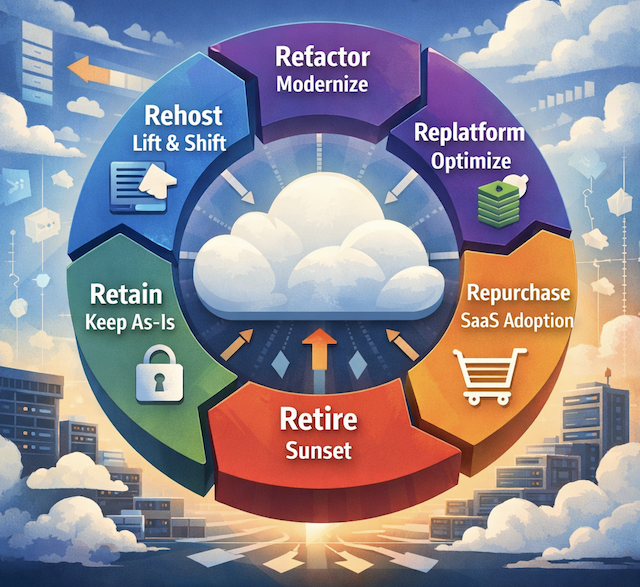
To answer these questions correctly, we must have a way to reason about these decisions. This is where the 6Rs migration framework comes in. The 6Rs were first introduced by AWS and have now become a standard model applicable to all major cloud platforms.
In this article, we propose a new version of the 6Rs based on the primitives of the cloud.
🔄 Vendor-Neutral View of The 6Rs Migration Framework
The migration strategies defined by AWS have similar definitions and stages across other vendors such as GCP and Azure, with only slight variations and negligible differences in the number of strategies. However, the 6Rs can be used as a common reference framework for architects and developers, regardless of the vendor or cloud provider.
They can even be applied within private cloud environments as a basis for defining migration policies.
| Strategy | Core Idea | Transformation Level |
|---|---|---|
| Retain | Keep as-is | None |
| Retire | Decommission | None |
| Re-factor (Re-architecture) | Redesign for cloud-native | Maximal |
| Re-platform | Optimize without redesign | Low |
| Repurchase | Replace with SaaS | High |
| Re-host | Lift and shift | Minimal |
The table above lists the six cloud migration strategies, independent of any specific provider or vendor. For each strategy, two key factors are described: the core idea behind the approach and the level of modernization and transformation involved. The meaning of transformation levels are as below:
- None: No change to the software or its ecosystem.
- Minimal: Pure migration (lift-and-shift) with no changes to code, architecture, or configuration.
- Low: Minor changes such as OS, runtime, or platform updates without modifying the codebase or architecture.
- High: Significant redesign including refactoring, adopting cloud-native patterns, or integrating managed and SaaS services.
- Maximal: Complete transformation involving a new code-base, technology stack, and architecture.
🛣️Strategy Overview
What really matters in cloud modernization is understanding that migration strategies don’t just determine where your system runs, but redefine how it maps to cloud primitives. In other words, each migration strategy changes how our application consumes and interacts with cloud-native building blocks.
The four key primitives involved in this transformation are outlined below:
- Compute Primitives: They define how your application code is executed in the cloud environment. Transformation impact is moving from static VMs to containers and Dynamic VMs like EC2 to fully managed serverless execution, increasing scalability and reducing operational overhead.
- Storage: They represent how data is stored, accessed, and managed in cloud. Transformation impact evolves from traditional disk/block storage to object storage and managed databases, improving scalability, durability, and availability.
- Networking Primitives: They handle communication between services and external clients. The transformation helps to shift from basic networking to cloud-native load balancing and service mesh, enabling dynamic routing, service discovery, and secure communication.
- Observability & Operations: Which covers monitoring, logging, tracing, and operational management. Transformation impact transitions from manual monitoring to centralized logging, metrics, and distributed tracing, enabling automation, reliability, and faster troubleshooting.
Re-host
Re-host or Lift & Shift involves moving applications to cloud-based VMs with minimal or no changes, which making it the fastest and lowest-effort approach to transformation. However, it often preserves existing legacy constraints and limitations.
Re-platform
Re-Platform or Lift, Tinker, & Shift introduces limited optimizations without changing the core architecture, such as moving from a self-managed database to a managed database service. It improves operational efficiency and maintainability without requiring a major redesign.
Refactor
Refactor or Re-Architect involves redesigning the system to fully leverage cloud-native capabilities, often adopting architectures such as microservices, serverless, or event-driven systems. It delivers the highest long-term value but comes with increased complexity and effort.
Re-Purchase
Re-Purchase migration strategy involves replacing the application entirely with a SaaS solution, such as moving a CRM system to a cloud-based platform. It shifts operational responsibility from the engineering team to the vendor, simplifying management but reducing customization control.
Retire
Retire is a migration strategy that involves decommissioning systems that no longer provide value, an approach that is often overlooked. It delivers immediate reductions in cost and complexity while simplifying the overall environment.
Retain
The last migration policy is Retain, which means keeping systems on-premises, either temporarily or permanently, due to compliance, latency, or business constraints. It requires a hybrid architecture approach to ensure seamless integration with cloud-based services.
⛔ Cloud Migration fallacies
Cloud Migration involves many common fallacies that architects and developers may encounter, and here we will explore some of the most important ones.
Decision-Making Is Linear
One of the biggest fallacies is to think of a single-choice model for each and every application migration, whereas in fact there is room for multiple models to be used within the same system.
For example. a monolith might be partially re-hosted, partially re-platformed, and gradually refactored over time. This is where architectural decisions comes into play and can avoid migration failure at the end.
Re-Host Strategy is cost Saving
Rehosting is done “as is” without any system optimization, which means that inefficient utilization, over-provisioning of resources, and legacy characteristics are migrated to the cloud. This could end up increasing costs since the cloud is a consumption-based model.
Cost savings are usually a result of optimization, which could include rightsizing resources, utilizing managed services, autoscaling, or even redesigning parts of the system, rather than a result of rehosting.
Re-purchase means simplification
This fallacy is based on the supposition that repurchasing always leads to a simplified ecosystem; however, this may not always be true.
Although SaaS provides a reduction in complexity with respect to operation costs, there may also be a vendor lock-in situation that may limit the flexibility of the system. Thus, repurchasing may simplify the operation; however, it may also cause complexity with respect to integration.
Re-factor or Re-Architect is Always Better Option
This fallacy or misunderstanding is based on the idea that refactoring to cloud-native is always the best solution, which is not necessarily the case.
Refactoring is a complex process, which means that a lot of design work is involved, and this could be a barrier for some applications, given that the complexity and costs involved could outweigh the advantages, given that the application is stable and does not need advanced scalability and flexibility.
However, the best solution depends on business requirements, where sometimes the simplest solution is not refactoring.
👍 Final Thoughts
The 6R framework is not a checklist; it is a decision framework that challenges architects to think in terms of trade-offs rather than tools. When we discuss cloud primitives, the conversation around migration is actually a discussion about the evolution of systems, where responsibilities fall between infrastructure, platform, and teams.
The real value here in cloud migration is not in the decision around a particular strategy; it is understanding the implications of that strategy over time.
While this article provides a good foundation for each strategy, nuances exist with each approach that simply cannot be discussed at a high level. In the next series of upcoming blog posts, we’ll take a deeper dive into each of the six strategies, so you can better understand how to apply each with clarity and confidence in your migrations.