👁️🗨️ From Vision to Architecture
In the first article of this series, we explored why API-First Transformation is a strategic imperative for organizations struggling with legacy systems.
But vision alone doesn’t transform enterprises. Architecture does. The real challenge is designing a bridge between legacy cores and the modern digital ecosystem.
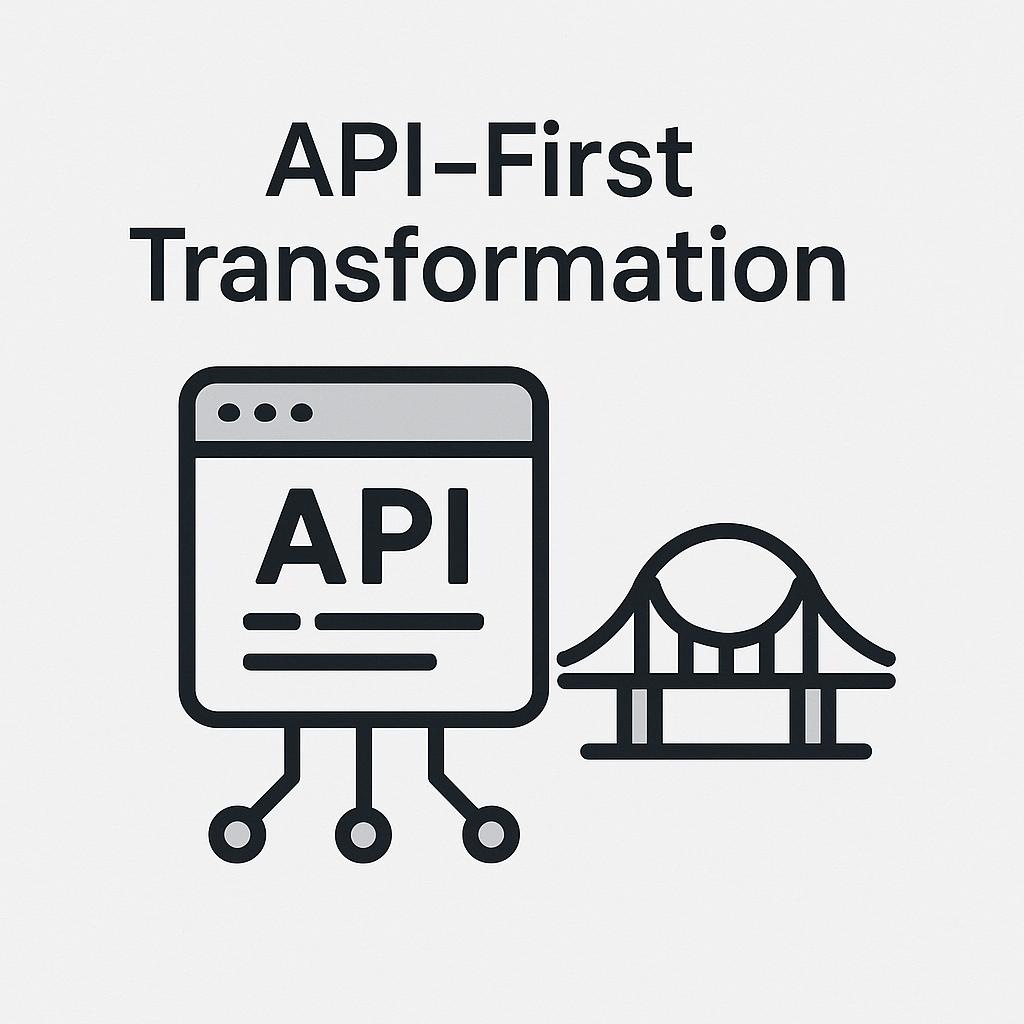
That bridge is built through API-First approach combined with SEDA, a design approach that allows organizations to unlock legacy value today while enabling safe, incremental modernization for tomorrow.
In this article as second article in this series, we’ll shift into the architect’s perspective on how API-First approach creates a solid foundation for transformation and the key patterns that make it work.
⛔ The Architect’s Dilemma
Architects and specifically enterprise architects live in constant tension. On one side are legacy ecosystems that are too critical to replace overnight. On the other are business demands and requirements for speed, agility, and seamless digital experiences.
Without SEDA and an API-First Approach, the transformation path forward often looks like this:
- A patchwork of point-to-point integrations that grow fragile and bug-prone over time.
- Legacy systems exposed directly, making every new service dependent on outdated protocols and technology stacks.
- A lack of governance and consistency that creates security risks and extra effort in long term.
And what is the result? Architectures that look like spaghetti diagrams, outdated, costly, and hard to evolve.
API-First Transformation offers a way out. It provides a disciplined, contract-driven foundation that both stabilizes today’s systems and sets the stage for tomorrow’s modernization.
🏰 API-First as an Architectural Foundation
Each stakeholder approaches a transformation from their own perspective business leaders, product owners, architects, developers, and operations teams all view success through different lenses. These perspectives are not only valid they are essential and must be considered from the very beginning of the transformation journey. An API-First Approach provides a common architectural language that aligns these viewpoints by defining how systems will communicate, how capabilities will be exposed, and how value will be delivered across teams and channels.
So what does API-first mean in architectural terms? Let us investigate in details in the table below.
| Architectural Foundation | Description |
|---|---|
| APIs as Decoupling Layers | APIs act as a buffer between legacy and new ecosystem. It means. new services and components never call legacy system directly; they interact only through well-defined APIs in transformed (newly implemented) system. |
| Capability-Centric Design | Instead of reflecting the structure of legacy systems, APIs are designed around business capabilities and business domains. |
| Contract-Driven Development | Architects define the API contract first, its resources, methods, and data models, and only then align systems behind it. |
| Governance by Design | In this phase such concepts like versioning, security, monitoring, and standards are defined and conceptualized in from the start. As a matter of fact, API-First doesn’t just connect both new and legacy systems, but defined new governance and workflow. |
These architectural concerns could be completed with patterns which are described in next section.
🗝️ Key Patterns for API-First Transformation
API-First Transformation is often discussed as a set of technical best practices, but in complex legacy environments this framing quickly breaks down. When APIs are introduced without a clear understanding of system behavior, organizational coupling, and change dynamics, they tend to formalize existing problems rather than resolve them.
Within a SEDA-driven transformation, API-First patterns are not selected for elegance or reuse, but because they address specific systemic tensions discovered through event analysis, structural observation, and feedback loops.
The patterns described in this section represent recurring structural responses to common challenges in legacy modernization: hidden dependencies, unstable boundaries, tight organizational coupling, and unsafe change. Each pattern helps translate systemic insight into stable contracts, enabling teams to evolve parts of the system independently while preserving overall coherence. Together, these patterns form an architectural vocabulary for turning API-First from an integration tactic into a strategic enabler of continuous transformation.
1️⃣ Contract-First Boundary Definition Pattern
In SEDA and DDD respectively, boundaries are not drawn arbitrarily; they are discovered through events, coordination hotspots, and leverage points. The Contract-First Boundary Definition pattern formalizes these discovered boundaries by defining APIs before implementation changes occur.
The API Contract becomes the explicit representation of a responsibility boundary that already exists implicitly within the system.
This pattern matters because it shifts APIs from access points to systems into structural constraints. By forcing clarity around inputs, outputs, ownership, and guarantees, the contract encodes strategic intent directly into the system.
💡Why it matters in API-First transformation?
Without contract-first boundaries, API-First initiatives often drift into endpoint sprawl, where interfaces mirror legacy structures and reinforce coupling. In contrast, when contracts are derived from SEDA discovery, they reflect system truth, not technical convenience. This dramatically reduces coordination overhead .
In practice, this pattern turns APIs into decision-making artifacts. They guide what is allowed to change, what must remain stable, and who owns which outcomes. That is why contract-first boundaries are foundational in API-First transformations grounded in SEDA.
2️⃣ Legacy Encapsulation Pattern (Anti-Corruption by Contract)
Legacy systems often embody outdated assumptions, data models, and workflows that no longer align with current business needs. The Legacy Encapsulation Pattern isolates these systems behind API contracts that reflect current domain meaning, not historical implementation details.
The API acts as a translation layer, protecting the rest of the system from legacy semantics.
From a SEDA perspective, this pattern emerges when event analysis reveals that legacy systems are a structural constraint rather than a leverage point. Instead of attempting to fix or rewrite them immediately, the transformation focuses on controlling how their behavior propagates through the system.
💡Why it matters in API-First transformation?
This pattern enables modernization without disruption. Legacy systems remain operational, but their influence is constrained. Over time, internal components can be replaced, decomposed, or reimplemented behind the same contract, enabling incremental evolution without cascading change.
As a matter of fact, this is not just a technical shield, but an organizational one. Teams no longer need deep legacy knowledge to make progress. The API contract becomes the shared understanding, reducing cognitive load and dependency on scarce expertise.
3️⃣ Evolutionary Governance via API Fitness Functions
Traditional governance relies on reviews, standards, and approvals (all forms of centralized control). Evolutionary Governance replaces these with fitness functions1 applied to APIs. It means, automated checks that continuously validate alignment with strategic and systemic goals. In SEDA, this pattern emerges from the need to balance autonomy with coherence.
APIs become the enforcement points where architectural intent is verified continuously rather than policed episodically.
💡Why it matters in API-First transformation?
This pattern allows organizations to scale change without scaling bureaucracy. Teams retain autonomy, but the system as a whole remains aligned with strategic intent.
Over time, governance shifts from control to guidance. The system learns, adapts, and corrects itself, which is exactly the outcome SEDA is designed to achieve.
💹 Business & Transformation Impact
API-First Transformation guided by SEDA is not primarily about improving integration quality or accelerating delivery in isolation. Its real impact lies in changing how the organization makes decisions, absorbs change, and evolves over time. By grounding architectural choices in systemic discovery and using APIs as execution contracts, transformation becomes less reactive and more intentional.
💡Impact for Architects
For architects, SEDA-driven API-First Transformation fundamentally changes the nature of architectural work. Instead of designing target states or prescribing detailed solutions, architects focus on revealing system behavior, identifying leverage points, and shaping stable boundaries. Architecture becomes less about control and more about structuring conditions for safe evolution.
This approach allows architects to operate at a truly strategic level. API contracts become the primary means of embedding architectural intent into the system. As a result, architects move away from governance-heavy models and toward evolutionary guidance, where alignment is maintained through contracts, feedback loops, and fitness functions rather than review boards.
💡 Impact for Developers
For developers, the impact is immediately tangible. Clear, contract-first API boundaries reduce ambiguity about responsibilities and significantly lower coordination costs. Teams no longer need deep knowledge of upstream or downstream systems to make progress; the API contract becomes the shared understanding that enables independent work.
SEDA-guided API-First Transformation also improves the safety of change. Developers can evolve internal implementations with confidence, knowing that stable contracts protect consumers from unintended impact.
💡 A Shared Outcome
For both architects and developers, the combined effect is a shift from project-based transformation to continuous transformation capability. Systems become easier to reason about, safer to change, and more responsive to business needs.
This is the core business impact of SEDA-driven API-First Transformation: not faster APIs or cleaner diagrams, but organizations that can change deliberately, safely, and repeatedly.
👍 Closing & What’s Next
API-First Transformation succeeds or fails not because of API design quality, tooling choices, or architectural styles, but because of how well it reflects the underlying system it is meant to evolve. When APIs are introduced without systemic understanding, they tend to preserve existing constraints and amplify coordination costs. When they are grounded in systemic discovery, however, they become one of the most effective mechanisms for enabling safe, incremental change.
SEDA reframes transformation as a sociotechnical problem first and an architectural problem second. By revealing how systems actually behave, it provides the strategic clarity needed to make API-First meaningful. In this context, APIs are no longer just integration points; they become contracts that encode intent, ownership, and evolutionary boundaries, allowing organizations to change without destabilizing themselves.
In the next article, the focus shifts beyond internal transformation toward the emergence of digital ecosystems.
- Fitness functions are like regular health checkups for your software. They’re automated tests that constantly monitor if your key business systems are performing as expected and meeting critical requirements, such as speed, security and reliability. Thoughtworks ↩︎